

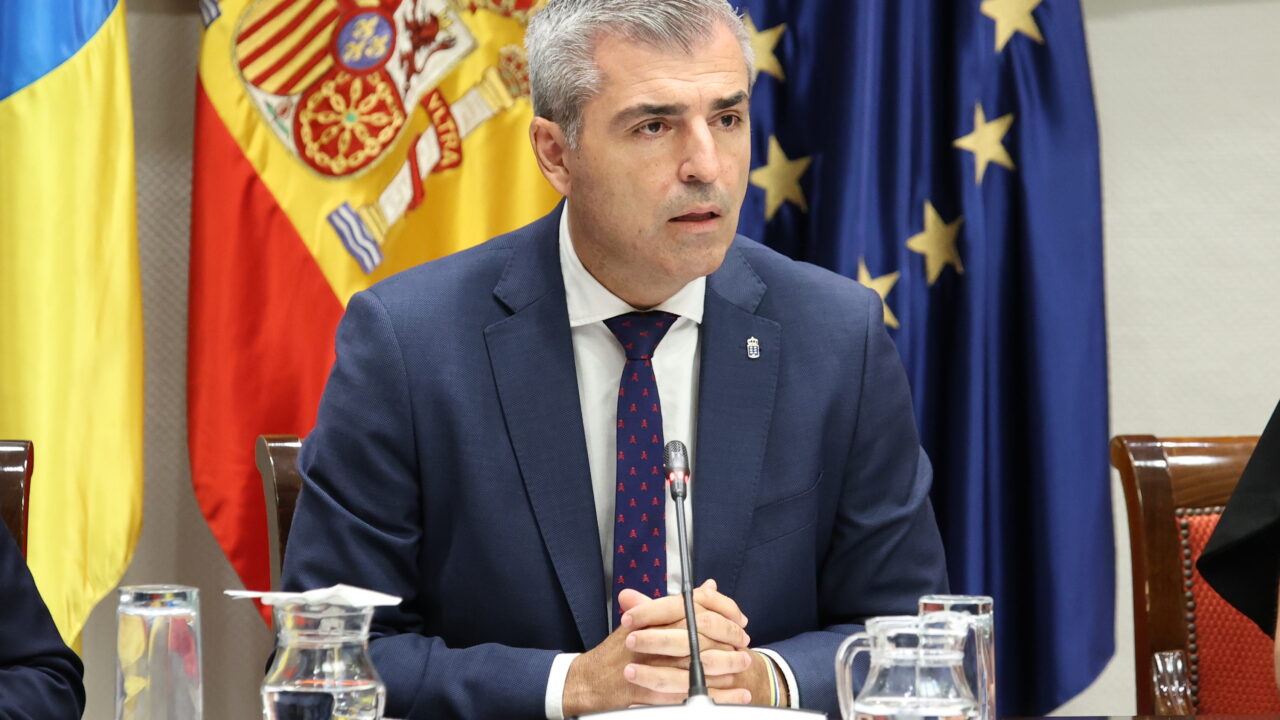
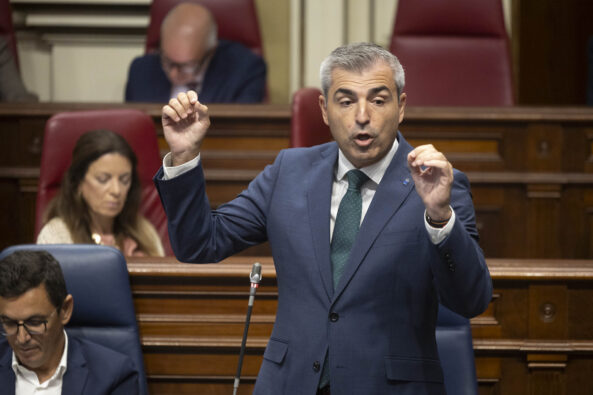
The Vice-President of the Canary Islands Government and Minister for the Economy, Manuel Domínguez (PP), defended his department’s budget on Tuesday, amounting to almost 95 million euros for 2027, with more than half of the funds earmarked for investment, whilst the opposition argued that the budget is «out of touch» with reality.
Domínguez presented his accounts to a parliamentary committee today; excluding staff costs, they show an increase of around 3 per cent.
He also said that they are following «five main priorities», namely support for self-employment, economic modernisation and diversification, industrialised housing construction, training and generational renewal, and internationalisation.
Canary Islands Budget: Department of Economic Affairs sets out five funding priorities
He highlighted, for example, that in the area of self-employment, programmes such as the ‚zero contribution‘ scheme, the support scheme, the ’second chance‘ scheme and ‚Reactívate‘ are still in place, in a context in which, according to Domínguez, the number of self-employed workers has increased by 9,543 during this parliamentary term.
On the subject of diversification, the Vice-President announced that the second phase of the ‚Leo‘ administrative simplification programme will be trialled through pilot projects with Adeje Town Council and the Tenerife Island Council, and mentioned, amongst the planned measures, four million for Industry 4.0 and other programmes relating to modernisation, the digitalisation of trade and the blue economy.
He has also championed the use of industrialised construction as a means of helping to resolve issues such as the housing crisis, with projects in Ingenio and Santa Cruz de La Palma, agreements with universities to research and develop prototypes, and technical offices aimed at promoting a production chain which, as he has acknowledged, is still «in its infancy» in the Canary Islands.
In the field of training, the Government aims to better align the provision of training with the profiles sought by businesses, offering courses in electrical maintenance, electromechanics, cyber security, renewable energy and welding, and has announced 60 training grants for international business.
Minister for Economic Affairs highlights cross-departmental measures
Domínguez has also defended the cross-cutting nature of his policies in the face of criticism regarding the modest budget growth, and has argued that improving productivity and competitiveness also requires action in areas such as training, taxation, energy and transport.
«There is always room for improvement,» he admitted, although he maintained that it is «a good budget» and rejected the idea that the ability to transform the economy can be measured solely by the resources specifically allocated to his department.
Opposition questions the effectiveness of economic spending
Socialist MP Tamara Raya has criticised the fact that the region’s overall budget is set to increase by 717 million, or 5.7 per cent, whilst the economic department’s budget is set to rise by just over two million, and has questioned whether this increase will be sufficient in the face of the economic slowdown forecast for 2027.
Raya has argued that, whilst the Government has enjoyed a favourable growth cycle during this parliamentary term, it has failed to transform the economic model, and has called for concrete results regarding the increase in industry’s share of the economy, the creation of businesses in strategic sectors, the mobilisation of private investment, and the survival of self-employed workers receiving financial support.
The spokesperson for Nueva Canarias, Luis Campos, has described the increase in the department’s budget as insufficient in relation to the overall budget growth, and has criticised the fact that, in his view, the proposal merely redistributes small increases amongst existing programmes.
Campos has linked this criticism to the Government’s own forecasts for 2027, which point to GDP growth of 1.1 per cent, inflation of 3.1 per cent and a rise in the unemployment rate, and has accused the Government of presenting a budget that is «out of touch» with its own economic assessment.
Nicasio Galván (Vox) has questioned the «business-as-usual» nature of the accounts and has argued in favour of drawing up budgets on a «zero-based» basis, rather than building on the previous financial year’s allocations, whilst once again calling for the responsibilities for Industry and Energy to be brought together within a single department.
Galván has warned that the shortcomings of the electricity system, referring to the latest power cut on La Palma, make it difficult to attract energy-intensive industries, and has called for a reform of the REF, fewer bureaucratic hurdles, the abolition of the AIEM to bring down the cost of the shopping basket, and a more favourable tax regime for the self-employed and businesses.
Government parties praise support for the self-employed
The groups supporting the Government, on the other hand, have welcomed the measures aimed at the self-employed and businesses; Rebeca Paniagua (PP) highlighted the 20 per cent increase in funding for the self-employed and the support programmes for industry and commerce, whilst José Javier Pérez Llamas (CC) focused on the zero contribution, benefits for temporary incapacity and the need to support the self-employed throughout the life of their business.
In the same vein, Melodie Mendoza (ASG) and Raúl Acosta (AHI) have argued that the budget specifically addresses the non-capital islands, although both have called for aid, investment and administrative simplification to be better tailored to the conditions of these territories.
Comments (0)
No comments on this article yet.