

Once again, an animal transporter is making headlines. There is a huge outcry. But this is mainly because the carcasses are spoiling the beautiful beaches. Our author believes that the animals‘ suffering is being pushed a little too far into the background.
No, I’m not a vegetarian. Nor am I a militant animal rights activist. I’m simply a thinking person. And what is happening on the beaches of Tenerife should prompt us to reflect on precisely this. Here are a few questions worth asking:
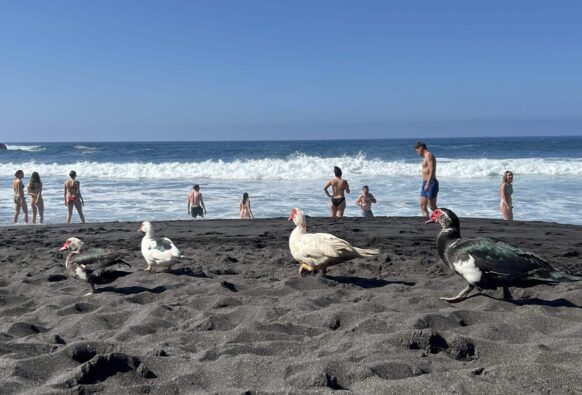
What on earth happened? Dead cows were washed up on a beach in Tenerife. It therefore makes sense to check which livestock vessels have most recently passed the Canary Islands. And indeed: there has recently been such a shipment. It is therefore highly likely that the animals died on the high seas and – despite strict bans – were thrown overboard by the crew.
What happened next? Then it turned out as it so often does on the internet: the first report still spoke of „dead cows on the beach“. Shortly afterwards, the headline changes to ’strange‘ or ‚bizarre finds‘, before moving on to ‚gruesome finds on the beach‘ and ’shock in the holiday paradise‘, and finally describing the ultimate ‚horror find‘. This has now become the standard progression of a negative news story on the internet.
OK, but what do the facts actually say? Almost in passing, the assumption that an animal transporter was to blame is presented as fact. Of course, it’s rather unlikely that the cows set off to go for a swim together and drowned. Of course, it is highly likely that the livestock lorry in question is to blame. But isn’t it the role of the judicial system to turn evidence – rather than mere conjecture – into established facts?
Why are there livestock transporters at all on the sea? This question gets completely lost in the discussion. Yes, you read that correctly: there are also livestock carriers at sea. They are a reality. And the conditions must be appalling. Hold on! That’s just an assertion, attentive readers of the previous paragraph might say. And they’re right! I’ve never been on board such a ship. At this point, I would refer to the following two reports, which, incidentally, have been confirmed:
Report 1: Livestock transporters – in the context of an online news story, they might just as well be called ’slaughter ships‘, which sounds far more sensational – regularly call at the Canary Islands. Sometimes they need to refuel; sometimes they run out of feed. This was the case, for example, in 2016. Veterinarians on Tenerife subsequently wondered how the latter could have happened at all, given the operators‘ many years of experience. And when they boarded the vessel to carry out a spot check, the conditions were so appalling that 300 animals had to be emergency-slaughtered. To reiterate: the animals were in such a terrible state due to the transport conditions that the veterinarians saw death as the only way out.
And secondly: Whenever a livestock transport vessel docks off the Canary Islands, the authorities receive complaints about the appalling stench. The smell of excrement can still be detected well into the city centre. It’s bad for business at the promenade bars, and unpleasant for holidaymakers who want to air out their hotel rooms or enjoy their balconies whilst taking in the sea view. Oh yes: and of course it’s also rather awful for the animals on board, obviously!
Who is responsible for this? The answer is almost too simple. It is: the consumer! Not, of course, for the specific offence. That has to be proven first. And then those responsible will be held to account. Although they are often merely following orders within an organisation. Yet they are driven by consumer behaviour at the meat counter. Anyone who thinks it’s a good deal that a chicken drumstick costs 29 cents in a discount supermarket’s special offer, or 100 grams of minced meat 36 cents, is deliberately turning a blind eye to the real problem. In a market economy, demand has determined supply for centuries. If cheap meat were no longer bought, it would no longer need to be mass-produced. And, incidentally, this would also help minimise food scandals, from rotten meat to horse meat lasagne.
So what now? What can I learn from this? As I said at the start: I’m not a militant vegetarian. I like meat. And yet I’m making a change. After all, it isn’t necessary for animals to be shipped around on the open sea for days, even weeks – in conditions that, according to vets, are barely sustainable – just for my evening steak, before being transported by lorry to the abattoir. The butcher’s round the corner also offers great products – often sourced directly from the local area after short journeys. These are then a little, and often a lot, more expensive. And that’s exactly where the shift in thinking begins. If I can no longer afford to eat meat every day – or at least not without a second thought – it regains the value that previous generations saw in it.
And what’s in it for me? In future, buy meat based on quality rather than price. In doing so, you’ll be doing yourself a favour too: animals are often subjected not only to stress but also to a cocktail of medicines to prevent – or at least minimise – the outbreak of diseases during long journeys. And it is precisely these medicines that end up in your stomach via the meat. There are studies which conclude that rising antibiotic resistance in humans may also be linked to the consumption of treated meat. And anyone who has ever experienced complications during a difficult course of medical treatment will suddenly realise that such a view isn’t so far-fetched after all.
I’m just an individual consumer. What can I possibly do? How often have you found yourself bored whilst queuing at the till? That’s when you really realise just how many individuals there actually are in the supermarket. If the 15 people in front of you also make a difference, that single individual suddenly becomes part of a significant group. One such significant group, for example, buys from a farmer in the Eifel out of conviction. This farmer does not give his animals antibiotics as a matter of routine. Nor does he need to, thanks to the spacious stables and extensive pastures. And he transports his animals to the abattoir in his own trailer. He keeps a full glass of water in the centre console of his car whilst doing so. If it doesn’t spill over, it means the animals travelled stress-free on their final journey. This meat is comparatively expensive. That is why, in contrast, there are livestock transport ships. Which brings us to today’s final question: Which method of animal transport will you actively be helping to fund with your next purchase?


No comments on this article yet.