


The Canary Islands hotel association, Ashotel, has accused the regional government of «double standards» over its new holiday let law. Politicians are patting themselves on the back for the new restrictions. It is suggested that housing will now become cheaper. Yet the decree is completely unsuitable for that purpose. The new rental law has, for the time being, absolutely nothing to do with more affordable housing.
In the wake of the pandemic, demand for housing in the Canary Islands has risen exponentially. With the introduction of new working-from-home arrangements, more people have temporarily relocated to warm and beautiful destinations. It is said that landlords have consequently increasingly made their properties available for short-term tourist lets. However, this view is too narrow.
One of the main reasons for the rising inflation rates is, in fact, the Spanish rent control scheme: as a result, more and more property owners realised that there was no rent cap for tourist accommodation. They promptly reclassified their properties. It took the government two years to pass a law to counter this. In the meantime, more flats were hastily reclassified, and under the new law, all licences already issued remain valid.
This tactical error on the part of politicians has led to a noticeable loss of traditional housing in the Canary Islands over the past two years. As for the remaining flats available for monthly rent, the interplay of supply and demand did the rest.
Canary Islands government sends the wrong signal to residents
The new law is intended to signal to residents of the Canary Islands that the government is committed to affordable housing. In reality, however, it merely places restrictions on further rezoning – far too late – and prohibits most local authorities from authorising new buildings specifically for tourist purposes.
Politicians resort to a common sleight of hand. Instead of admitting their failure, they point to something that suggests an improvement. In reality, however, this merely prevents the situation from deteriorating at the same rate from this point onwards.
In fact, the new law does not automatically lead to more affordable housing, as it merely slows down the previous rise in prices. There is, however, only one sustainable and successful way to create more affordable housing: social housing. And politicians have been aware of this for decades – far longer than the situation has reached precarious proportions.
Tenerife: 35 affordable flats in 14 years
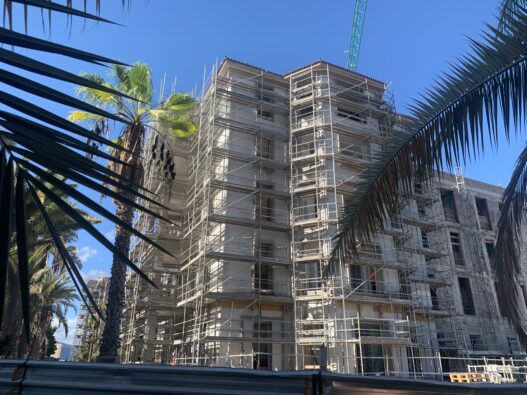
Arona on Tenerife is a perfect example of these failures. There, locals need affordable housing to live close to their places of work in this predominantly tourist-oriented area. A construction project for 35 social housing flats took 14 years to complete. And to this day, no one has moved in.
«This is yet another example of the situation in Arona: things aren’t going well, and there’s a lot to be done because a great deal of land is tied up,» says Javier Baute, the councillor responsible at the town hall. The council sits on one of the largest building plots in Spain. The plans there mainly involve luxury flats, whilst local residents are waiting for affordable housing. The project has been stalled for almost 30 years.
Meanwhile, the social housing flats planned in 2002 remain vacant. Instead of giving at least some families the chance to live affordably close to their place of work, the city spends 6,000 euros every month on private security services to ensure that the vacant social housing flats are not occupied by squatters.
Anyone who dreams of affordable housing for the masses should have been rudely awakened, if not already, by the parliamentary popping of champagne corks to mark the new rent decree. For whilst politicians in the Canary Islands are celebrating the new law, rents for their residents will not be a single euro cheaper.




«Canary Islands Government misleads the public with new holiday home law»
No comments on this article yet.