

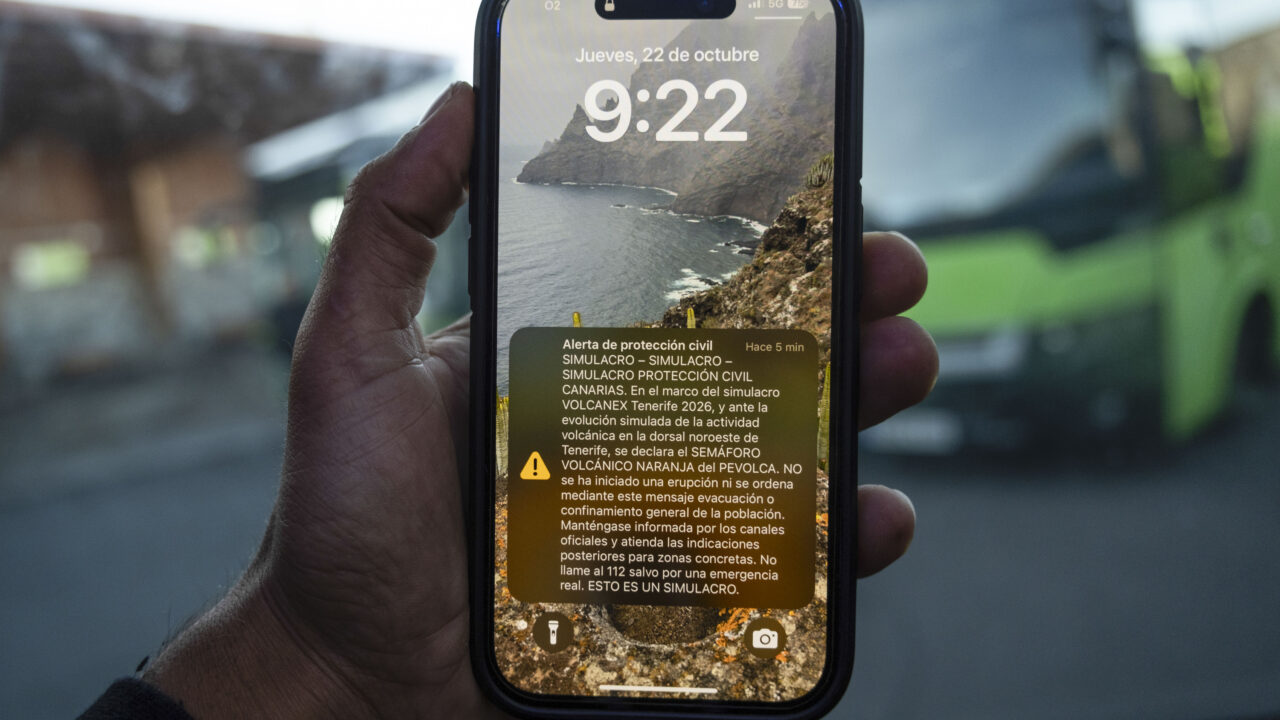
On Thursday, the island of Tenerife carried out a drill to test its response to a possible volcanic eruption in the south of the island, as part of an exercise called Volcanex, which involved the evacuation of residential and tourist areas and the mobilisation of all available resources in the event of an emergency.
The drill, the second of its kind to be held on the island in the last two years, the previous one took place in Garachico, was organised by the Tenerife Island Council, but involved 70 public, scientific and emergency management bodies, with some 1,500 people taking part.
The event, which took place between 7.00 am and 2.00 pm, affected the municipalities of Guía de Isora, Santiago del Teide and Adeje.
Volcano drill: Warnings trigger the evacuation of 300 residents
It began with an initial ES-Alert at 9.00 am sent to all mobile phones on the island, and the Tenerife Island Council’s Forward Command Post raised the volcanic risk alert level to orange.
A second Es-Alert has been issued, but only for mobile phones in Guía de Isora, instructing residents to evacuate the villages of Chirche and Aripe.
During this operation, the president of the Island Council, Rosa Dávila, ordered the evacuation of around 300 residents from these villages in Guía de Isora; arrangements were made for them to be taken to a temporary shelter.
The operation involved both organising transport and registering residents, a vital procedure for identifying individuals, recording their circumstances and facilitating their monitoring during the operation.
Both the President of the Island Council and the Mayor of Guía de Isora, Ana Dorta, emphasised the need for the highest possible level of coordination between all public authorities and the emergency services in situations such as this.
Furthermore, Dávila has stated that the priority is to ensure the safety of local residents, to anticipate any risks and to rely solely on information provided by official channels.
In addition, a hotel, a care home for the elderly, Teide National Park and the Corona Forestal have been evacuated.
Evacuations in the tourism sector
In the tourism sector, the plan initially involved confining visitors to their hotels and, subsequently, evacuating non-residents from the Las Terrazas de Abama hotel in Guía de Isora by coach.
During the drill, the evacuated tourists were taken to a safe area in Adeje, from where the subsequent arrangements for their transfer to the airport and boarding procedures were organised.
The operation has also involved providing information to those affected and liaising with consular authorities to facilitate communication and assistance throughout the process.
Tenerife: Care home and nature reserves are being evacuated as a precaution
An evacuation drill was also carried out at the Santa Gema Care Home for the Elderly in Santiago del Teide, using transport adapted to the needs of its residents; however, before the transfers began, an individual triage process was carried out to verify the destination assigned to each person and to determine the necessary means of transport.
The operation involved coordination between the dispatching centre and the receiving centre, as well as the evacuation of people with reduced mobility.
In addition, Teide National Park and the Corona Forestal Nature Reserve were closed and evacuated as a precautionary measure to ensure the safety of those present in this natural area.
Volcano monitoring tracks seismic activity, ground deformation and gas emissions
During the drill, the director of the National Geographic Institute (IGN) in the Canary Islands, Itahiza Domínguez, pointed out that assessing volcanic activity requires continuous monitoring of various parameters, such as seismic activity, ground deformation and gas emissions.
It is the combined analysis of these parameters that enables us to identify changes in the behaviour of the volcanic system and assess its possible future development, the expert said.
The head of Civil Protection at the Tenerife Island Council, Néstor Padrón, has pointed out that the activation of a maximum alert is the starting point for a response that requires planning, coordination and operational capacity.
The Canary Islands Emergency Service has also highlighted the importance of these training sessions, which help to improve response times in real-life situations and enable healthcare professionals to foster collaboration between the service and the various groups involved.

Comments (0)
No comments on this article yet.