36 walking routes across the lava fields of Teide National Park
Trails range from two hours to a full day, and only 150 people a day may stand on the summit, with a permit from the national park office. Warm layers and sturdy shoes are advisable even near the cable car station.
Johannes Bornewasser is an author, journalist and editor-in-chief of Teneriffa News. He is regarded as a recognised expert on the Canary Islands. Bornewasser is also responsible for the editorial content of the website.
4 min read
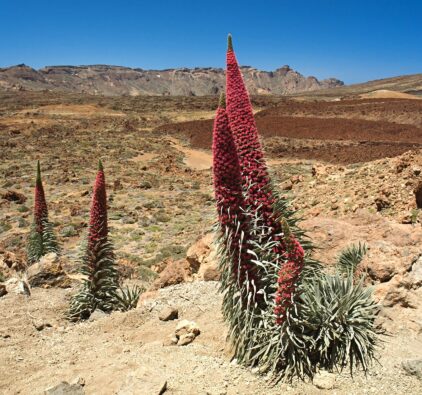
Tenerife offers a variety of walking routes. Photo: Johannes Bornewasser
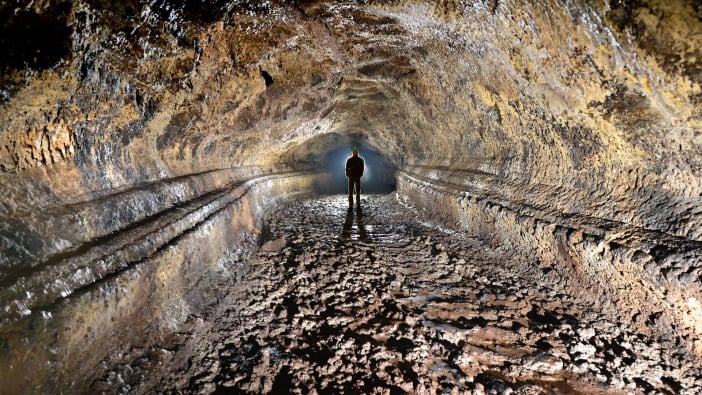
Birds chirp here and there, a gentle breeze can be heard from time to time, and the basalt rock crunches underfoot. During its last eruption in 1909, the El Chinyero volcano hurled these black rocks – some of which are several metres in size – through the air for kilometres with unimaginable force.
However, the volcanic landscape of Mount Teide National Park is not only popular with film producers, but also with walkers. It offers 36 routes of varying degrees of difficulty. They take between two hours and a whole day to complete. The routes vary not only in length, but also in terrain.
Whether it’s climbing up and down rocky lava hills, trudging through drifting volcanic ash or taking a leisurely stroll through the Canary Islands pine forest – there’s something to suit every taste. Signposts and maps help you find your way, and if you’d like more information, you can book a hiking guide. Knowledge of Spanish isn’t essential; many of the hiking guides speak German.
Hiking through eternal spring
Oliver, a Spaniard with Bavarian roots, has been guiding tourists through the volcanic landscape of Tenerife for ten years. The man with the Spanish-Bavarian accent explains: «The Canary Islands are very popular with walkers. That’s because they have a pleasant climate and beautiful wildlife that is unique.»
Temperatures on this Spanish archipelago in the Atlantic, off the Moroccan coast, hardly fluctuate throughout the year. They are usually around 22 degrees during the day, which is why the Canary Islands are also known as the ‚Islands of Eternal Spring‘. And the fauna is remarkable for its enormous diversity.
A climb up Mount Teide is a must
The significant differences in altitude across the islands have created entire microclimate zones: from the subtropical climate on the coast, through the forests at higher altitudes – home to many endemic plants and animals – to the barren yet fascinating mountain landscape at lofty heights.
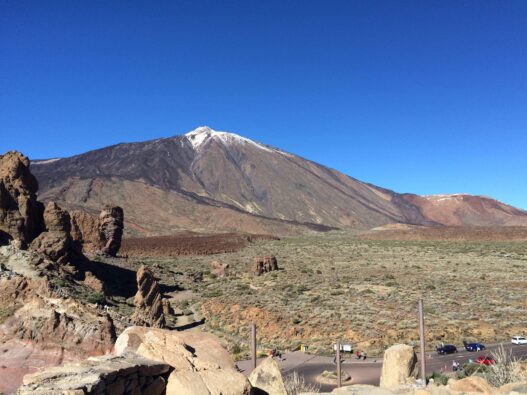
A must-do for hikers on Tenerife is the ascent of Spain’s highest mountain, Mount Teide. The 3,781-metre-high volcanic peak is not only the centrepiece of the national park, but of the entire island. Visitors can take the cable car up to 200 metres below the summit. Even at that altitude, you can feel how thin the air is. You start to feel the strain of breathing more quickly than usual.
Anyone wishing to reach the summit should therefore be fit. And they should obtain a permit from the National Park office, as only 150 visitors a day are allowed to go all the way to the top. However, there are also some fantastic climbing routes to be found around the volcano.
Guided walking tours for you:
But a car journey or a trip on the public bus to the viewpoint is also well worth it: from a plateau, a cable car takes walkers up to the top. It usually ends above the cloud cover, where the sun is always shining. It’s still important to take warm clothing with you, though, as the wind blows strongly. In winter, there’s even snow. Sturdy footwear is also advisable, as you’ll be walking over volcanic rock even on the paths around the cable car station.
Hiking through fairytale cloud forests around Mount Teide
The fairytale-like cloud forests, in which laurel trees use their leaves and aerial roots to draw moisture from the clouds, offer a lovely contrast to the rugged beauty of the volcanic landscapes. In the Anaga Mountains in the north-east of the island, visitors can hike through the enchanted laurel forest on three different, relatively easy routes.
One of the trails is even designed to be accessible, so that children and pensioners can walk it with ease. Along the way, the ‚Path of the Senses‘ features stations where you can smell, touch and observe – there’s plenty to discover – making it the perfect walking trail for beginners and families.
We are familiar with the walking routes on Tenerife described here, but cannot guarantee that the routes will remain accurate in the long term. Construction work or natural forces may alter the paths. We thank you for your understanding!





«Tenerife tip: Hiking through Mount Teide National Park»
No comments on this article yet.