

General satisfaction despite rising crime rates. Fewer people out of work whilst the population remains stable. A significant increase in European tourists and, consequently, more staff in the hospitality sector. Lower electricity consumption despite rising prices. And around five million bus-kilometres. The year 2013 provided a wealth of figures, data and facts for the Canary Islands. We’ve compiled them:
Population remains stable
The population of the Canary Islands has remained more or less stable. Last year, a large number of residents left the islands. Even dozens of emigrants who had initially sought their fortune on Tenerife, on Fuerteventura, on Gran Canaria & Co., were drawn back to their homeland. According to figures from the national statistics office, the population of the Canary Islands fell by 0.27 per cent in 2013. The slight decline was particularly noticeable in Tenerife. In Las Palmas, by contrast, the figure was just 0.02 per cent.
Fewer unemployed in the Canary Islands
As regards unemployment figures, the year ended on a positive note. The number of unemployed fell to 274,053 by the end of the year. This represented 10,862 fewer unemployed than in 2012, corresponding to a fall of 3.81 per cent.
In November, for the first time since 1997, fewer people were registered as unemployed than in the previous month. In the Canary Islands, there were 931 fewer registered unemployed than in October. This represents a fall of 0.33 per cent. Compared with the same month last year, there were as many as 5,824 fewer unemployed (-1.96 per cent). Nationwide, there were almost 2,500 fewer unemployed people than in October. This brought the total number in Spain down to just over 4.8 million people.
Nevertheless, there is no reason for the Canary Islands to rest on their laurels in the face of this positive trend: Young people in particular are finding it increasingly difficult to find a job. Whilst there were 23,000 unemployed people aged between 16 and 24 in 2007, the figure now stands at 56,000 – despite some having very good qualifications.
Tourists are spending more money
The Canary Islands government reports that tourists spent a good 11.6 billion euros more whilst on holiday. This represents an increase in turnover of around 11.6 per cent and corresponds to the second-largest growth in the whole of Spain. According to the report, British tourists were the most generous, accounting for about one-fifth of total revenue, whilst German visitors ranked second with 16.5 per cent. In Tenerife alone, visitors spent nearly 3.7 billion euros more last year (+5.2 per cent).
Number of overnight stays in the Canary Islands rises
Although hotel stays have become around 2.4 per cent more expensive on average, the total number of overnight stays in the Canary Islands has risen: hotels in the Canary Islands recorded 59.3 million overnight stays (+5.4 per cent). Visitors stayed for an average of 7.4 days.
More budget and all-inclusive tourists
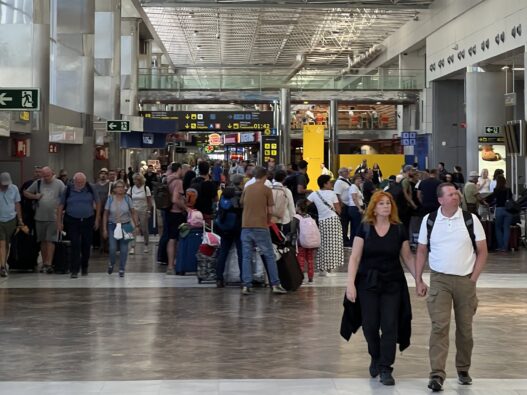
The Canary Islands narrowly missed setting a record in 2013. A total of 32.5 million holidaymakers were counted at the airports. This meant that just under one per cent fewer tourists arrived on the archipelago than in the previous year. Whilst Tenerife North Airport recorded a remarkable increase of 16.4 per cent, La Palma, with 13.3 per cent fewer holidaymakers, and Fuerteventura (-0.4 per cent) brought the overall figures down significantly.
Low-cost airlines recorded a substantial increase. 4.6 million passengers travelled to the Canary Islands with these carriers. This represents a rise of 3.4 per cent. Traditional airlines also saw an increase. 5.9 million passengers were carried, a rise of 5.7 per cent.
Overall, however, the number of holidaymakers arriving on the islands from Europe rose by almost five per cent. With 10.6 million visitors, a new record was even set. From Germany and the UK alone, there was an additional 13 per cent increase in the number of holidaymakers visiting the Canary Islands.
The Canary Islands saw a particular rise in all-inclusive holidays: more than 3.2 million holidaymakers opted for such packages. According to government figures, this accounted for almost 29 per cent of all holidaymakers. The previous year saw around 400,000 fewer all-inclusive holidaymakers.
Ports report a rise of almost 15 per cent
Significantly more tourists also travelled to the islands by sea. According to figures from the tourism authority, the increase across the 17 largest ports stood at 14.4 per cent (a total of 3.1 million travellers). Freight transport by sea also rose (+2.2 per cent).
Fewer employees in the hotel and hospitality sector
Presumably also due to rising revenue in the tourism sector, the number of people employed in the hospitality industry rose by more than five per cent. By the end of the year, the figure stood at 197,751.
Space tourism from the Canary Islands
Last year, a Swiss company cleared the first hurdles towards opening a base for commercial space flights on Gran Canaria. To this end, a base costing around 60 million euros is to be built at the airport on the Canary Island. Up to 85 new jobs are expected to be created.
Retail sector satisfied
According to the Canary Islands Retailers‘ Association, a decline in turnover was recorded. However, this amounted to just 0.3 per cent. In December, the increase had still stood at 5.1 per cent. This positive figure was not enough, however, to save the annual average. By way of comparison, the Balearic Islands recorded an increase of 2.8 per cent.
More self-employed people
According to figures from the Job Centre, a significantly higher number of Canary Islands residents took the plunge into self-employment in 2013. With an increase of up to 5.8 per cent in the provincial capitals of Tenerife and Las Palmas, the figure is significantly higher than in the previous year.
Electricity consumption is falling, prices are rising
According to energy suppliers, electricity prices in the Canary Islands are set to rise. The percentage increase is not yet clear. Speculation suggests it could be between 1.4 and four per cent. Meanwhile, consumption has fallen. According to the Canarian electricity company ‚Endesa‘, total consumption fell by three per cent. In Tenerife, the figure was around four per cent; in Gran Canaria, just under three per cent; and in Lanzarote, 2.5 per cent. Fuerteventura saved just under two per cent on electricity, whilst the remaining islands together recorded a saving of 6.2 per cent. This is attributed in particular to energy-saving light bulbs and more modern, and consequently more energy-efficient, household appliances.
Cost of living in the Canary Islands falls
Despite isolated price rises, the cost of living in the Canary Islands did not increase in 2013. In fact, the average cost of living was almost half a percentage point lower than in 2012. This was announced by the Ministry of Economic Affairs.
220 Construction projects in the new year
In the new year, 220 major construction projects are set to get under way in Tenerife alone. According to the island’s president, Carlos Alonso, 87.7 million euros are to be made available for this purpose, despite tight budgets. The bulk of this is to be spent on road construction, infrastructure and measures to tackle unemployment. An additional loan of 25 million euros has been taken out for the expansion of tourist centres.
Puerto de la Cruz is getting a facelift
The first spending of this kind was made last year in Puerto de la Cruz, in northern Tenerife. As a result, property sales there rose by 56 per cent. The town, where the first tourists to the Canary Islands once settled, had long had to yield to the burgeoning south in terms of tourism and property prices. However, to counter this trend, the government launched a regeneration programme set to run until 2014, with the aim of making Puerto competitive once again. The upturn in property sales figures – which had been poor for a long time – is seen as a milestone in this process.
Property prices
Property prices continued to fall in 2013 – albeit at a slower rate. In the province of Las Palmas, prices for second-hand homes fell by 6.5 per cent. Since the start of the crisis, the decline has thus totalled 35.5 per cent. A square metre there currently changes hands for an average of 1,267 euros.
Public transport on Tenerife
The 250 drivers of Tenerife’s bus company Titsa have covered more than five million kilometres, transporting 34 million passengers in the process. This means the company recorded around two million fewer passengers than in the previous year. Although the company already receives subsidies, there is still a financial shortfall of around 400,000 euros (45 per cent).
Earthquakes in the Canary Islands
The ground has been shaking repeatedly over the course of the year, particularly off the coast of El Hierro. The strongest tremor was recorded in December. However, at 5.1 on the Richter scale, the quake remained within normal limits. In some places, the island even rose by up to eight centimetres. In addition, gas emissions from the ground have more than doubled. They are currently occurring at depths of between 12 and 18 kilometres off the coasts of La Restinga and La Frontera. Researchers expect further seismic activity this year as well. However, there is no cause for concern.
Oil drilling begins
The search for oil has begun after much back-and-forth. A long dispute had flared up between the government, conservationists and tourism associations over possible negative consequences. Towards the end of the year, the first drilling operations finally took place between Fuerteventura and Lanzarote, on the one hand, and Morocco, on the other. However, no oil reserves have been found so far.
The farce surrounding Tenerife’s oil refinery
The Santa Cruz oil refinery on Tenerife had to be shut down in the summer. Local residents had repeatedly complained about the stench. The public prosecutor’s office even launched an investigation after a citizens‘ initiative commissioned an expert report accusing the refinery of environmental pollution. Operations were suspended again the day before Christmas Eve, but resumed four days later following an inspection. Residents continue to call for the refinery to be relocated outside the city limits, but politicians consider this to be unaffordable. It is highly likely that this farce will continue this year as well.
Speaking of the environment: the long-running issue of a deposit scheme for single-use items was also raised on several occasions this year. However, no agreement has yet been reached.
Numerous drug seizures
On Christmas Eve, the Guardia Civil scored yet another major success in the fight against drug trafficking. Officers had repeatedly recorded both minor and major drug seizures. Shortly before the turn of the year, a further 300 kilograms of hashish were seized on a ship off the coast of Arinaga. Two people were arrested.
Second-hand car market in decline
According to the Canary Islands Car Dealers‘ Association, the value of second-hand cars fell by 3.6 per cent last year. On average, Canarians spent around 12,000 euros on a second-hand car.
New hospitals on Tenerife
New hospitals are to be opened in the north and south of Tenerife. The first to be completed is expected to be the one in the south, later this year. A further four million euros was approved for this purpose at the end of 2013.
Comparing insurance policies saves millions
The government has launched a review of insurance policies covering all official properties and assets, thereby identifying potential savings of 1.6 million euros in one fell swoop. Following amendments to the contracts, the estimated costs for this year now stand at just 3.9 million euros.
Tax audits on Tenerife
Improvements are also planned in the area of taxation. Tenerife’s capital, Santa Cruz, alone intends to generate additional revenue of up to three million euros through more thorough audits. The audits began last year but are not expected to yield results until this year.
Animal welfare
In Puerto de la Cruz on Tenerife, 150 animals in distress were rescued. During operations carried out by local animal welfare activists, animals that have been acquired illegally or are being kept in conditions unsuitable for their species are taken into care.
Crime on the rise
Crime has risen by around 30 per cent since the start of the crisis. Just under 8,000 offences were recorded in the province of Tenerife, whilst in the province of Las Palmas the figure stood at a good 7,000.
Satisfaction rises, yet more people are leaving
More than three-quarters of all residents of the Canary Islands are satisfied with their lives, according to an official survey. Nevertheless, just under 32,000 residents have left the Canary Islands for economic reasons and emigrated to Europe. This particularly affected mainland Spaniards who had previously tried their luck in the islands‘ mild climate.
Fewer children in care
At the turn of the year, the number of children living in care homes fell from 1,021 the previous year to 821.
Just under 280,000 pensioners
At the end of the year, there were 279,988 pensioners living in the Canary Islands. With an average pension of 805 euros, they receive around 57 euros less than pensioners on the Spanish mainland.
Forest fires and natural disasters
Forest fires destroyed just under 59,000 hectares of land across Spain in 2013. In the Canary Islands, the number of bushfires fell significantly following the extreme year of 2012. There, only just over one per cent of the land area was devastated by forest fires. By the end of the forest fire season, 182 fires had been recorded. As a result of these and other natural disasters, 662 families have so far required support. 2.5 million euros have been made available for this purpose. The number of people in need of assistance due to natural disasters is to be revised upwards, as not all applications have yet been processed.
The wettest month since 2009
According to meteorologists‘ calculations, December was the wettest month since 2009. The data shows that an average of 140 litres of rain fell per square metre in the Canary Islands. Tenerife, La Palma, El Hierro and La Gomera were particularly affected. This was mainly due to the winter storms.
Organ donations are on the rise
According to the health authority, there were 264 organ donations, resulting in significantly more transplants than in the previous year (+6.8 per cent). In addition to twelve living donors, organs from 69 deceased donors were transplanted. A total of 140 different recipients benefited from these donations.
>>> You can find the 2014 year in review here <<<



«2013 in review: The Canary Islands in facts and figures»
No comments on this article yet.