

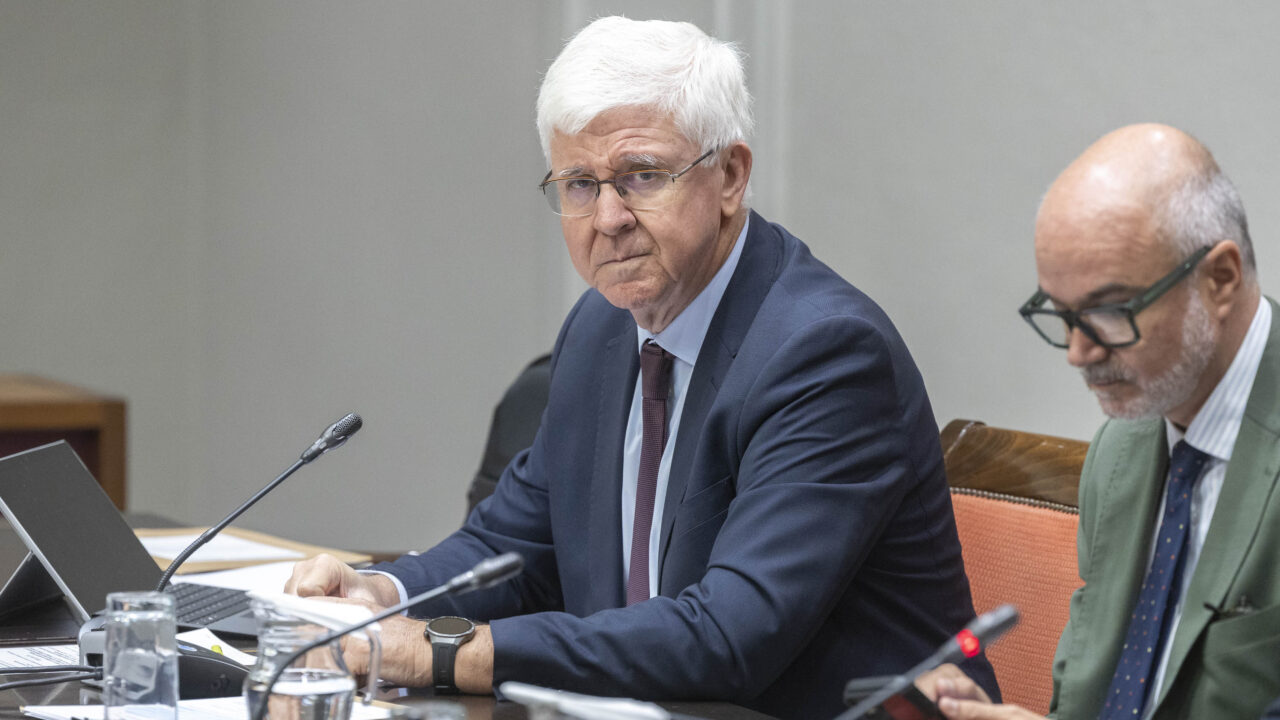
Two ministers from the Canary Islands Government submitted their declarations of assets after the deadline, whilst two others did not record any activities in their public diaries, according to one of the two reports on corruption prevention presented on Monday to a parliamentary committee by the President of the Canary Islands Court of Auditors, Pedro Pacheco.
The report on the status of senior officials, which examines documentation from 2024 and 2025, states that the Regional Ministers for Ecological Transition and Energy, Mariano Hernández Zapata, and for Public Works, Housing and Mobility, Pablo Rodríguez, missed the three-month deadline for submitting their declarations of assets and only submitted them after being reminded several times.
As for the ministers who, at the time these reports were drawn up, were not publishing their diaries, these are the ministers responsible for Industry, Trade and the Self-Employed, Manuel Domínguez, and for Health, Esther Monzón.
Canary Islands Government: 94 public officials fail to disclose their diaries
The lack of transparency regarding their agendas did not affect just the two ministers; it extends to 94 of the 158 senior regional officials, including several heads of deputy ministries and directorates-general.
«The agenda is a key tool for monitoring conflicts of interest,» warned Pedro Pacheco during the presentation to the parliamentary committee of the two reports containing preventive recommendations, one on the institutional integrity of the regional administration and the other on the status of senior officials.
The Court also questions the fact that there is no consistent standard in the diaries of senior officials, and that some entries are limited to travel or duties inherent to the post, but do not reveal with whom public officials meet or what matters they discuss.
The National Audit Office calls for modern rules for senior public officials
Regarding asset declarations, Pacheco stated that senior officials generally comply with the obligation to submit them and that any non-compliance was ultimately rectified in the course of the report.
As the Audit Office points out in its report on the status of senior officials, the 1997 Canary Islands regulations have become obsolete and, amongst other measures, it calls for the restrictions and authorisations regarding private employment following the end of a term of office to be clarified, as well as for verification of compliance.
Another recommendation is to introduce at least two compulsory annual ethics training sessions, as, according to the information provided to the Court, only 18 senior officials had received training on these topics in 2024, with no evidence of their attendance.
Gender parity varies significantly across the Canary Islands' departments
With regard to gender parity, the report notes that, of the 158 senior positions analysed, 95 were held by men and 63 by women, approximately 60 per cent and 40 per cent respectively.
However, there was a very marked male majority in the deputy ministries, as well as imbalances between departments, such that in Agriculture there were eight men and two women, and in Social Welfare, four men and ten women.
Corruption prevention in the Canary Islands remains patchy
With regard to the report on institutional integrity within the regional administration, the Regional Audit Office warns that «there is still much to be done», as there is no comprehensive, coordinated and adequately staffed strategy for the effective prevention of fraud and corruption.
Preventive measures focus on the requirements for the management of European funds under the Recovery, Transformation and Resilience Plan, but there are no general codes of ethics, conduct or good governance that extend beyond that EU funding.
The Court also criticises the delay of more than fifteen months in establishing a secure channel for whistleblowers reporting potential irregularities, and the fact that only three of the eighteen public companies audited had an internal whistleblowing scheme that complied with legal requirements.
Pacheco also pointed out that the establishment of an external reporting channel through an independent authority, to which whistleblowers can turn, is still pending.







Comments (0)
No comments on this article yet.