


In a report on the mass influx in Ceuta, the Spanish police have warned of new boat arrivals in the Canary Islands via the Atlantic route. The document was drawn up by the National Centre for Immigration and Borders of the Spanish National Police. It was sent to the Central Criminal Court. We have a copy of it.
On 30 and 31 July, around 80,000 migrants had arrived in the exclave, which has a resident population of roughly the same size. Whilst Ceuta was still dealing with the aftermath, the General Commissariat for Foreigners and Borders, the «Comisaría General de Extranjería y Fronteras» (CGEF), forwarded a warning to the police headquarters in the Canary Islands. It was reported that there was a risk of more irregular boats reaching the islands.
According to investigators‘ assessments, migratory pressure could shift back from the Mediterranean to the Atlantic. The document states that an «increase in the revival of migration flows from Morocco towards the Canary Islands» is to be expected. Specifically, along this route:
Police report warns of a resurgence in migration to the Canary Islands
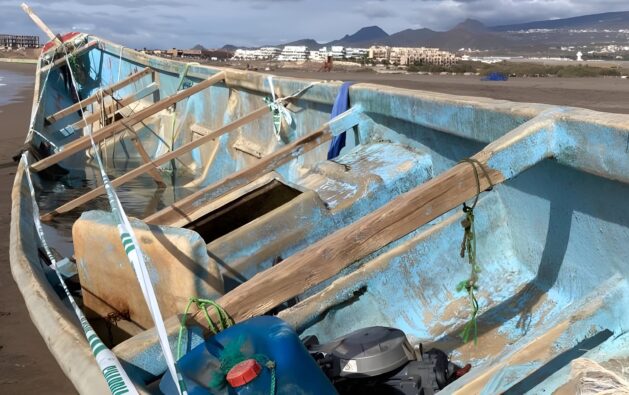
For the islands, the report describes a separate corridor from Tantán in Western Sahara to the Canary Islands. It goes on to state that the well-known, unseaworthy boats, known on the islands as «cayucos», would be used for this purpose. This route was explicitly distinguished from the routes from Nador to Almería, from Tangier and Assilah to Cádiz, and from Castillejos to Ceuta.
According to the document, virtually all irregular maritime migration from Morocco to Spain is carried out via people-smugglers. Based on the records of the General Commissariat, the report states that 98.13 per cent of cases between 2023 and 2026 were carried out by criminal organisations.
According to the report, five groups had the capacity to transport dozens of people at a time, totalling 200 to 300 migrants per day. Most of them were active in northern Morocco and along the Spanish Mediterranean coast, whilst one of them covered Morocco’s Atlantic coast and the Canary Islands. The report goes on to state that there are networks on both sides, including staff in Spain.
Confidential report on migration to Spain and the Canary Islands
Depending on the point of departure, various modes of transport were used: fast motorboats originally used for drug smuggling, rubber dinghies and wooden boats, as well as fishing boats acting as mother ships, which took people out into international waters and transferred them to smaller boats there.
With regard to the Atlantic route, the report specifically refers to «unseaworthy boats», which are therefore unsuitable for crossing the Atlantic. The investigators describe the typical profile as sub-Saharan men aged between 15 and 25 from Sahelian states and the Gulf of Guinea region. They are said to be there almost exclusively to travel on to the Canary Islands.
The Canary Islands recorded a record number of irregular migrants in 2024. Around 46,800 people arrived in the archipelago that year. It was only through agreements with African states that these migrants and refugees were actively prevented from setting sail. As a result, arrival figures this year have fallen by around 60 per cent. This is precisely the concern now: if African authorities and border officials were to actively allow migrants to set sail again, this could mean a return to the conditions of that time for the Canary Islands as well.
Criticism and doubts regarding the Ceuta report and its implications for the Canary Islands
The report sparked criticism primarily because of the passages concerning the actions of Moroccan border officials, whom the report accuses of «actively guiding» migrants – some in uniform, some in plain clothes – as well as displaying «total permissiveness» (letting them through) during the crisis. In response, Interior Minister Fernando Grande-Marlaska demanded an explanation from Police Director Francisco Pardo.
Spanish media reports differ regarding his response: whilst «El Debate» reports that Pardo merely denied that the report proved Morocco’s direct «intellectual authorship», other sources reported that Pardo had completely denied the existence of such a report in this form to the Ministry. Ultimately, the dispute over the document casts doubt on the government’s previous account of events at a politically sensitive time: Prime Minister Pedro Sánchez is expected to address Parliament on the matter for the first time shortly.
The document leaves open the question of who initiated the mass influx: it refers to ‚prior planning‘ and ’strategic direction‘ without naming those responsible. As such, the document alone is not sufficient, at least, to unequivocally attribute the planning to the Moroccan government.






Comments (0)
No comments on this article yet.