

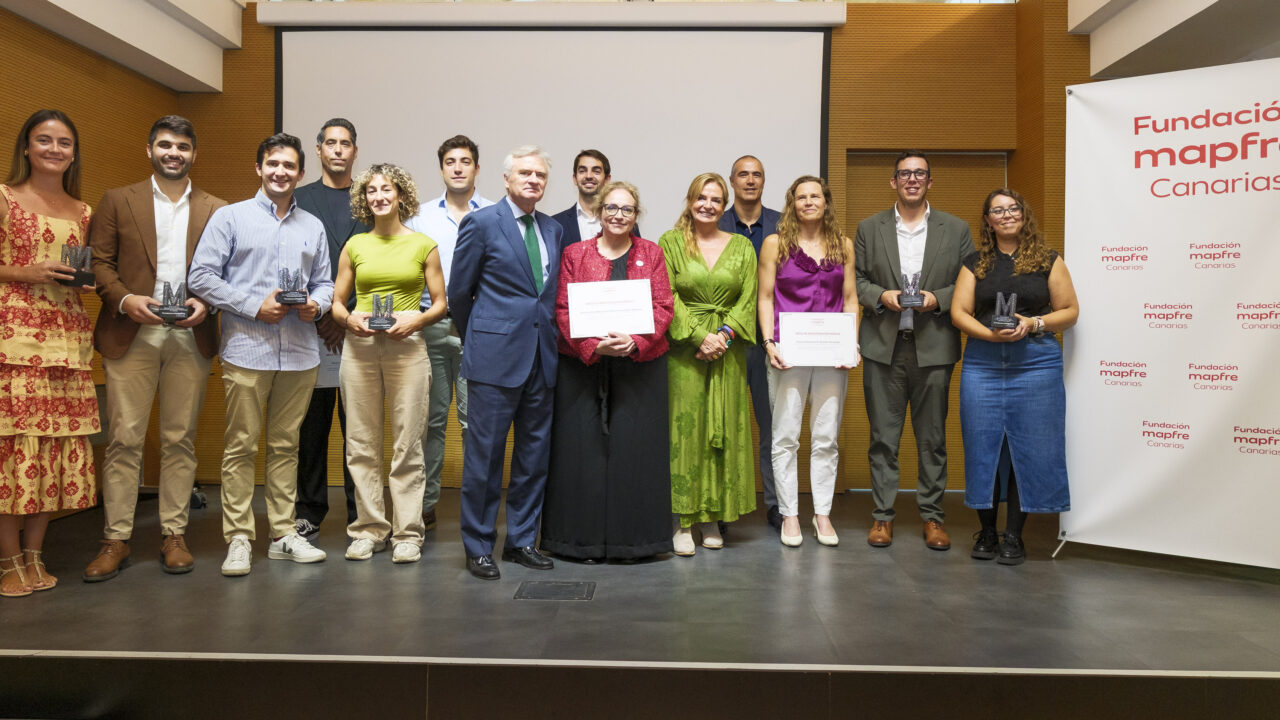
On Wednesday, the Mapfre Canarias Foundation presented its awards to the most outstanding medical interns (MIR) of the year at the islands‘ public hospitals, worth 5,000 euros each, as well as four grants of 20,000 euros for healthcare research.
With this contribution of 110,000 euros towards the MIR Awards and medical research grants, the total funds mobilised this year by the organisation in support of public healthcare in the Canary Islands and its professionals now stand at 246,500 euros, as highlighted by its representatives
The president of the Mapfre Canarias Foundation, Ignacio Baeza, has said he is «proud» of these awards, which enable the foundation to «continue supporting healthcare in the Canary Islands in all its forms, whilst also demonstrating that public-private partnerships work».
Canary Islands: Foundation supports research into common diseases
Baeza welcomed the fact that this year’s awards recognise projects linked to common diseases in the Canary Islands, «such as diabetes, respiratory diseases and lung cancer».
The Foundation «has always supported healthcare in the Canary Islands, because it is a direct way of improving people’s lives» through the work of professionals and research that «has an impact on society and is put into practice right here in the Canary Islands».
The same view was expressed by the Canary Islands Government’s Regional Minister for Health, Esther Monzón, who described this initiative as «an example of public-private collaboration» both in research, which «is essential for the advancement of medicine», and for junior doctors, providing them with support «when they complete their specialisation, which is undoubtedly very important».
Research grants support asthma and cholesterol projects
Carlos Cabrera, a pulmonologist at Doctor Negrín Hospital, has welcomed the fact that this grant will enable progress to be made in the research project ‚Eosinophilic subtypes as surrogates for Th2 inflammation‘. The importance of iEos‘, which spans «from the cell to the doctor’s surgery», working on «methods to aid in the diagnosis of asthma and bring to light many cases of asthma that are currently undiagnosed and which could benefit from treatments» that have so far only been recommended for the most common groups.
«Research is always difficult; it requires a great deal of effort and dedication», although, he said, «it is a wonderful way to approach medicine».
Ana Wägner, an endocrinologist at the Hospital Insular and acting on behalf of Rosa María Sánchez, principal investigator of the project ‚Analysis of the genomes of patients with familial hypercholesterolaemia carrying a mutation prevalent in Gran Canaria and its association with diabetes‘, has been awarded a grant to investigate a condition that causes very high cholesterol levels and, consequently, an increased risk of cardiovascular disease, particularly heart attacks, at an early age.
«70 per cent of people who test positive for familial hypercholesterolaemia have the same mutation, and this is something extraordinary that occurs in very few places in the world,» said the researcher.
The grant will enable further research into this mutation, which is particularly prevalent on the island, and help to identify common features across different families and «the genetic factors that cause some families to develop diabetes and others do not», amongst other diseases.
Diabetes and lung cancer are the focus of research
Yeray Novoa, a paediatric endocrinologist at the Canary Islands University Hospital, has been awarded a grant to «gain a deeper understanding of the genetic basis of type 1 diabetes» in children in the Canary Islands, which has «the highest incidence in Spain and one of the highest in Europe», for reasons that «are not yet fully understood».
With this project, he explained, «we aim to shed light on the cause of these very high figures in our population, develop specific panels for screening programmes in the Canary Islands, and identify people at risk of developing this disease».
This financial injection, Novoa has said, «means we will have significant genetic sequencing capacity, as the cost of genetic testing is high, and this grant represents a step forward in terms of the number of patients we will be able to study».
Dr María Cecilia Martín Fernández de Basoa, of the Nuestra Señora de la Candelaria University Hospital, has been awarded a grant for the ‚LUCAS 2.0 (Lung CAncer Screening)‘ project, a pilot study to validate a lung cancer screening model based on tumour markers in the blood.
Lung cancer, this researcher has pointed out, has overtaken deaths from heart disease in the Canary Islands and, amongst women, has even surpassed breast cancer, which further highlights the need for an «earlier» diagnosis. «It is very silent and by the time it is detected, it is often already too late,» she noted.
Using a blood sample, this project could identify tumour markers and save lives because, as she has said, «there are treatments for this type of cancer and, if detected early, the survival rate is high».
Junior doctors receive funding for further specialist training
As regards the awards for junior doctors, nine doctors from the four university hospitals in the Canary Islands have received this recognition; they will be given financial support to continue their specialisation (there are six awards, but in several categories the prize has been shared equally between two people).
This was revealed by Pablo Alonso, from the Hospital Insular de Gran Canaria, who will continue his specialisation in gastroenterology, focusing on «the technical aspects of endoscopy and specialised techniques», with plans to complete his master’s degree and continue his specialisation in Japan.
Almudena Monllor, a urology specialist at the Nuestra Señora de la Candelaria University Hospital, spoke of her «pride» at receiving this award: «This is just the beginning. After five very tough years of my residency, this marks the start of my career and my training to give patients the very best of myself.»
For his part, the neurologist Juan Francisco García, from the Doctor Negrín University Hospital of Gran Canaria, explained that «this is recognition of years of training» during which «we have also devoted ourselves to research and patient care».
In the coming years, he explained, he will use this financial support to «establish myself and continue my training in both research and clinical work». EFE
1011668



Comments (0)
No comments on this article yet.